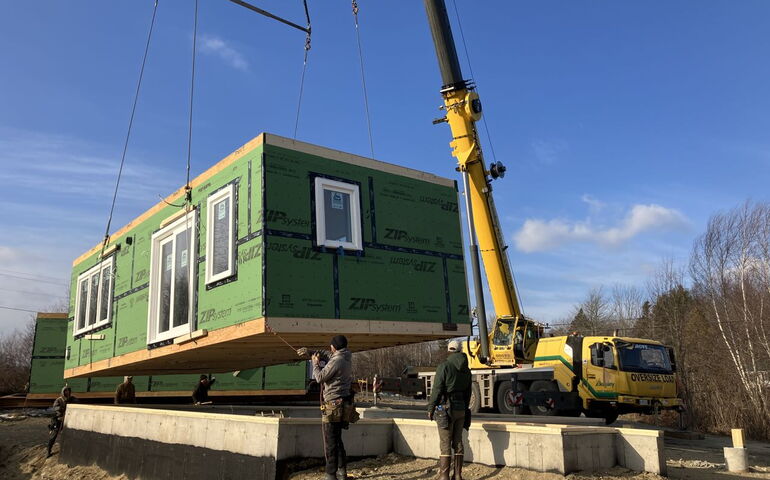
Zero Energy Homes, a startup that develops modular homes for the affordable housing market, teamed up with design-build firm Knickerbocker Group to manufacture modular units for a home in Trenton.
The units were set on their foundation this week at 12 Fairway Vista Road.
“Modular homebuilding has many benefits, such as allowing us to build consistently year-round regardless of the weather outside,” said Mattie Bamman, Zero Energy Homes’ communications coordinator.
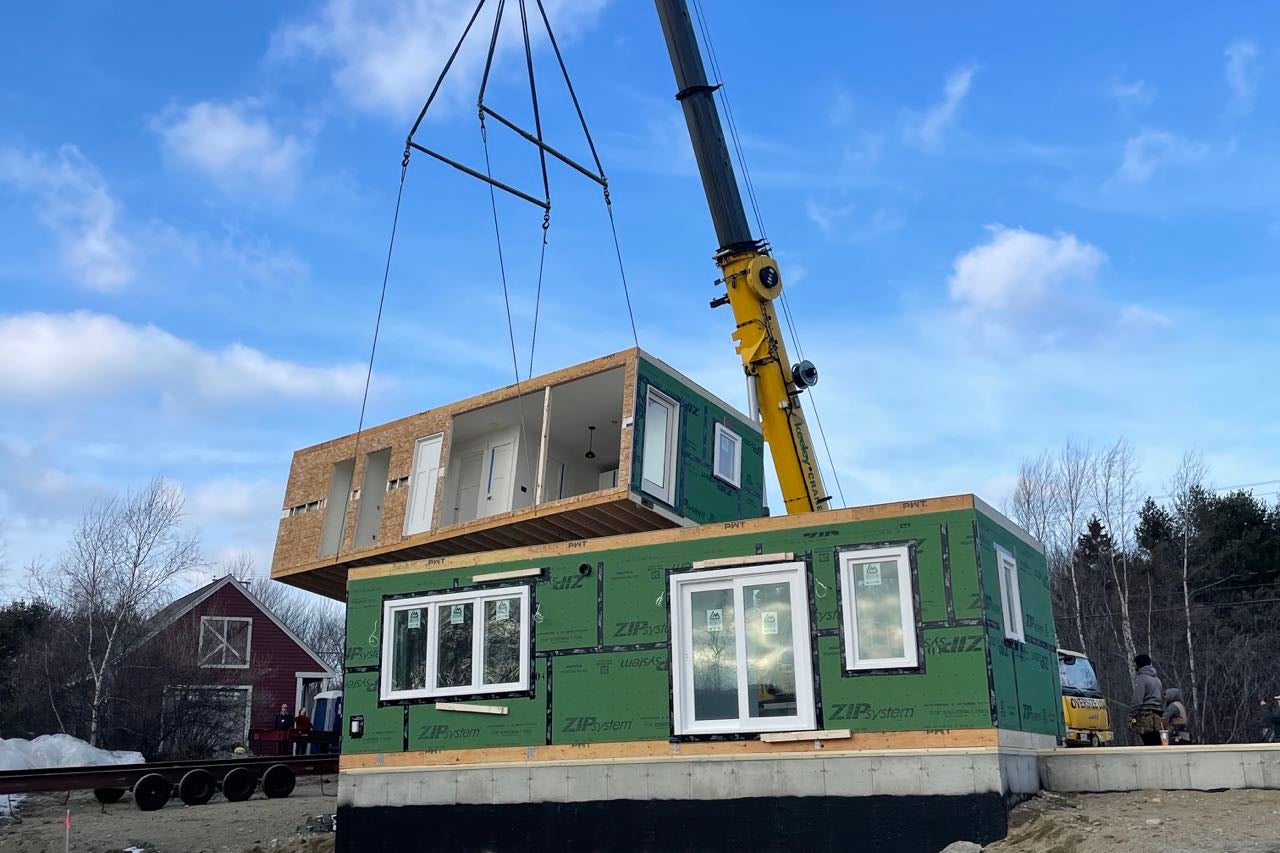
Modular and panelized construction is trending up for residential and commercial builds, providing greater certainty around construction timelines and replicable design details and efficiencies and making it easier to train employees and retain older workers.
Prefab startup
Zero Energy Homes, founded and led by Caroline Pryor and located in the Hancock County town of Mount Desert, completed its first project earlier this year in Searsport.
The two-bedroom, one-bath, single-family home aims to show that modular construction combined with “net zero energy” principles can be priced for the affordable housing market. The house was priced for buyers whose income is 80% of the area’s median income.
Energy-efficient features include wood-fiber insulation, 10-inch-thick walls, a well-insulated roof, heat pumps, an energy recovery ventilation system, triple-glazed windows, energy-efficient appliances and lighting and a solar array.

A building that operates at net zero energy generates as much power as it uses.
Zero Energy partnered with Maker Construction, a firm in Hebron that specializes in modular and panelized home construction and earthwork, to build the wall, floor and roof sections in panels.
Knickerbocker connection
Founded in 1978, Knickerbocker has offices in Boothbay and Portland. Since January 2023, it has operated an 18,000-square-foot manufacturing facility at 518 Gardiner Road in Wiscasset, where it produces modular units for its 800-square-foot and 500-square-foot home designs and delivers them to construction sites.
Zero Energy and Knickerbocker worked together on the design for the Trenton home.

To date, including Zero Energy, Knickerbocker has built units for 11 homes for clients mainly in the midcoast region, said Julien Jalbert, Knickerbocker’s architect and design studio leader.
Greater efficiency
The Searsport house is built from pre-fabricated panels that were flat-packed for shipping and assembled on site.
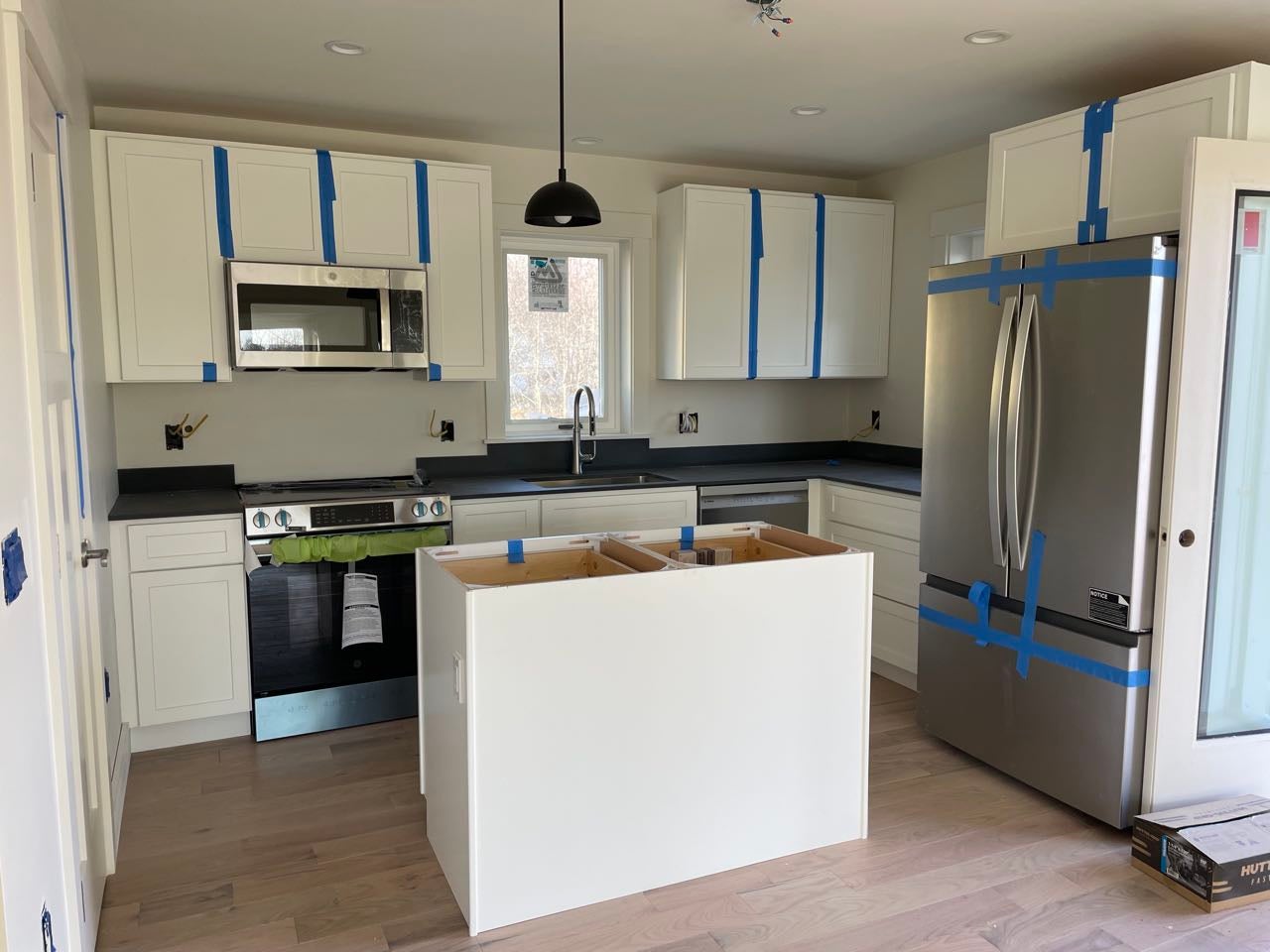
By contrast, the Trenton home is Zero Energy’s first modular build. Units were prefabricated at Knickerbocker’s Wiscasset facility and come with installations such as counters, cabinets and appliances, and the drywall and flooring about are 90% complete. The on-site work includes wrapping up the flooring and drywall and making the final connections for electrical, plumbing and roof.
The Trenton home is the same 896-square-foot design, called the Osprey, that was built in Searsport. Maker Construction delivered modular know-how and additional skilled labor.
The modular technique took four months, compared to 10 to 14 months for a conventional stick-built home, said Jalbert. The timesaving translates to lower project cost thanks to greater efficiency and minimal waste in a controlled shop environment.
For the materials and crew, being out of the weather is nothing to sneeze at either.
The Osprey design is priced at about $300,000, depending on options. Many prospective buyers are Mainers who have acquired a piece of land, said Steve Eaton, who was hired in May as Zero Energy’s vice president of manufacturing.
The Trenton house is Zero Energy’s third project. Earlier this month, the company set an insulated shell for a home on the Blue Hill peninsula. The buyer is a retired general contractor who will complete the project, working with local trades, said Bamman. The shell product can be $100,000 to $125,000.
“That is a home product that we think we will work for a number of Mainers, bringing their own skills and sweat equity to the contract,” he said.
Other projects are coming up, Bamman said. And the sale of the Searsport home is expected to close soon.
Manufacturing facility
The company has a larger goal: to build a modular manufacturing facility for efficient, year-round construction of its homes. Eaton is in charge of the site search, with a goal to be up and running by the end of 2026.
“There are a number of options out there to expedite our move to modular,” Eaton said.
The company is looking for a lease of 15,000 to 20,000 square feet, ideally in the Ellsworth, Old Town, Belfast radius, he said.
Open houses for the Searsport house have attracted at least 200 people.
“We’ve gotten amazing feedback,” Bamman said.