Lewiston says ‘no’ to proposed AI data and technology center for Bates Mill
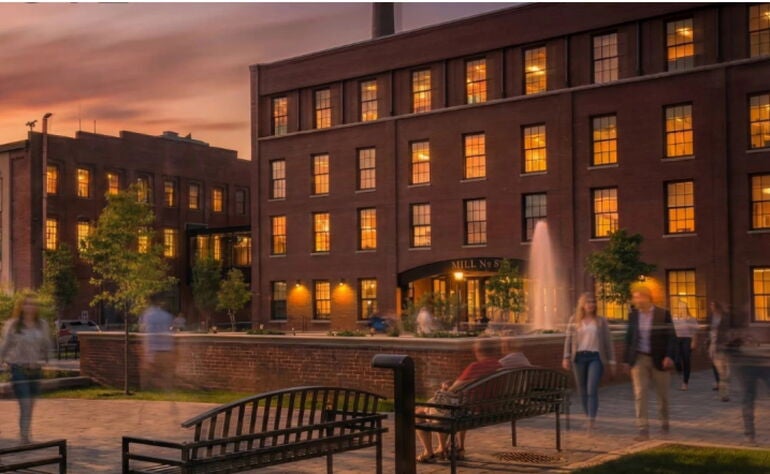 Rendering / MillCompute LLC
A rendering of Bates Mill No. 3 if it were repurposed as an AI data center.
Rendering / MillCompute LLC
A rendering of Bates Mill No. 3 if it were repurposed as an AI data center.
A proposal by MillCompute LLC to develop an artificial intelligence data and technology center in Bates Mill No. 3 in downtown Lewiston was unanimously voted down by City Council Tuesday night.
The proposal called for using 85,000 square feet of the vacant property at 140 Mill St. and creating up to 30 jobs.
City Council rejected the proposal by a vote of 7-0.
The $300 million project was proposed by Lewiston native and building owner Bill Johnson, whose Twin Cities LLC partnered with MillCompute LLC. Johnson has redeveloped several city properties, including Bates Mill No. 3.
Documents included in City Council members’ packets for the meeting noted, “MillCompute LLC has established a team that includes local leadership and experts from across the country in data center construction, operation and finance.”
MillCompute’s website lists no address or principals.
Opposition cited several concerns
Over 100 residents had communicated their opposition to the project ahead of Tuesday night’s council meeting and another 15 spoke against it during the standing-room-only meeting at Lewiston City Hall.
Concerns cited included environmental impact, potential electricity rate hikes, whether the developer had a proven track record for this type of project and if there wasn’t a better use for the former mill.
Local public school teacher Jae Zimmerman suggested the property could be better utilized as “a desperately needed second middle school” or day care center. She said the project would conflict with the Riverfront Island master plan and, echoing the sentiments of fellow speakers, added, “Downtowns should be for people, not machines.”
Residents also rejected the proposed tax breaks for the project, arguing that such efforts should be directed to existing Lewiston businesses.
A proposed 20-year tax increment financing and credit enhancement agreement “to support extraordinary energy costs” would have returned 90% of property taxes to the developer for the first 10 years, and 85% for the following 10 years. Annual tax revenue to the city would have been $798,250 for the first decade and $965,000 for the final 10 years.
Council members needed no additional persuasion. All seven voiced their opposition to the project prior to the public hearing, noting they had received overwhelming complaints about the proposal.
“This is the topic that I’ve received the most feedback on in my time on City Council," said Scott Harriman, who represents Ward 3.
David Chittem, who represents Ward 6, said that while he felt the concerns over water extraction from Lake Auburn were unfounded, the project had “a number of other problems."
“It had the potential for being a great project and may still, but not with the time constraints that have been imposed upon it," Chittem said.
The Bates Mill complex dates to 1870 and includes 11 former mill buildings, some of which have been repurposed, totaling over 1 million square feet. The four-story Bates Mill No. 3 building is 169,000 square feet.
Mainebiz web partners
Most Recent



Most Recent







0 Comments