
FILE PHOTO / JIM NEUGER
Toby Dewhurst
Please do not leave this page until complete. This can take a few moments.
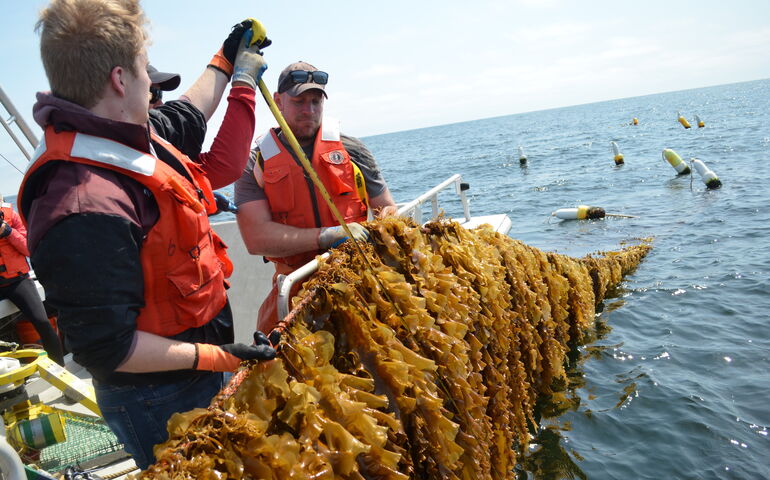 Photo / Courtesy Toby Dewhurst
Kelson Marine and collaborators sample kelp grown on an open-ocean seaweed farm.
Photo / Courtesy Toby Dewhurst
Kelson Marine and collaborators sample kelp grown on an open-ocean seaweed farm.
Farming kelp is an expensive endeavor, in some scenarios costing about $2,618 per metric ton. But a new tool developed in Maine could help trim that cost to $383.
Researchers at Kelson Marine Co. in Portland and the University of Maine developed software that provides a detailed economic overview for growers.
The tool analyzes dozens of design and operational factors — including site-specific ocean and meteorological conditions, species-specific crop characteristics and growth, workboat types and sizes, labor structures, on-board kelp processing or storage techniques, shoreside infrastructure and maintenance schedules.
“By using this tool to investigate the comprehensive implications of any given farm design or operational decision, we can help kelp farmers meaningfully reduce production costs and achieve economic sustainability,” said Zach Moscicki, an ocean engineer with Kelson Marine leading the project.
Kelp is used as food and in beauty products, fertilizer additives and other goods. Maine leads the nation in seaweed farming — and the industry is growing. Each spring, around a million pounds of kelp are harvested from ocean farms by Maine fishermen and families who grow it over the winter.
Most of the kelp is incorporated into seaweed salads, sauces, kelp burgers and health foods, then distributed to restaurants and retailers.
But a barrier for incoming farmers is a lack of cost-analysis tools to help reduce expenditures and develop sustainable business plans.
Enter the engineering capabilities of Kelson Marine. Led by CEO Toby Dewhurst, the engineering consultant specializes in predicting how highly dynamic structures will perform and survive in the ocean.
Kelson has developed simulation tools for engineering complex ocean structures for applications such as ocean renewable energy and aquaculture.
The company partnered earlier this year with the Alaska Mariculture Cluster and Alaska Fisheries Development Foundation on a similar project focused on ocean modeling, data collection and analysis for shellfish and seaweed farming.
Kelson’s exports in 2024-25 included designing systems for New Zealand, the United Kingdom, Canada, Norway and the Faroe Islands.
Kelson Marine and UMaine — supported by scientists from the University of New Hampshire, Woods Hole Oceanographic Institution in Massachusetts and Vertical Bay, Maine — tested analytical software to analyze the production costs of a hypothetical sugar kelp farming operation occupying 1,000 acres, about 12 miles from shore, at a site with a water depth of 330 feet.
Researchers tested several scenarios, including multiple farm designs and operational models.
The tool predicted that operating a kelp farm that is simply designed for low structural costs and high production volume would cost $2,618 per metric ton of fresh kelp.
By using the tool to test design and operational changes, the team cut the cost by 85%. They came up with improvements that included deeper cultivation lines, mechanized harvest and seeding operations, processing the kelp on-site into a slurry, optimizing vessel sizes and selecting different vessels.
The work was supported with funding from Conscience Bay Research, the Builders Initiative and the U.S. Small Business Administration.
Structural analysis tools developed and validated under the U.S. Department of Energy’s Advanced Research Projects Agency-Energy Macroalgae Research Inspiring Novel Energy Resources program were applied.
“What is exciting about this new model is that it is the most comprehensive and detailed cost analysis of offshore kelp growth in the U.S. to date,” said Damian Brady, a marine sciences professor at UMaine. "This type of analysis helps us find pain points where investments in technology can rapidly change the cost-benefit analysis.”
The Giving Guide helps nonprofits have the opportunity to showcase and differentiate their organizations so that businesses better understand how they can contribute to a nonprofit’s mission and work.
Learn More
Work for ME is a workforce development tool to help Maine’s employers target Maine’s emerging workforce. Work for ME highlights each industry, its impact on Maine’s economy, the jobs available to entry-level workers, the training and education needed to get a career started.
Learn More
Whether you’re a developer, financer, architect, or industry enthusiast, Groundbreaking Maine is crafted to be your go-to source for valuable insights in Maine’s real estate and construction community.
Learn moreThe Giving Guide helps nonprofits have the opportunity to showcase and differentiate their organizations so that businesses better understand how they can contribute to a nonprofit’s mission and work.
Work for ME is a workforce development tool to help Maine’s employers target Maine’s emerging workforce. Work for ME highlights each industry, its impact on Maine’s economy, the jobs available to entry-level workers, the training and education needed to get a career started.
Whether you’re a developer, financer, architect, or industry enthusiast, Groundbreaking Maine is crafted to be your go-to source for valuable insights in Maine’s real estate and construction community.
In order to use this feature, we need some information from you. You can also login or register for a free account.
By clicking submit you are agreeing to our cookie usage and Privacy Policy
Already have an account? Login
Already have an account? Login
Want to create an account? Register
In order to use this feature, we need some information from you. You can also login or register for a free account.
By clicking submit you are agreeing to our cookie usage and Privacy Policy
Already have an account? Login
Already have an account? Login
Want to create an account? Register
This website uses cookies to ensure you get the best experience on our website. Our privacy policy
To ensure the best experience on our website, articles cannot be read without allowing cookies. Please allow cookies to continue reading. Our privacy policy










0 Comments