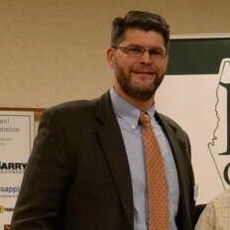
File COURTESY / PROFESSIONAL LOGGING CONTRACTORS OF MAINE
Dana Doran
Please do not leave this page until complete. This can take a few moments.
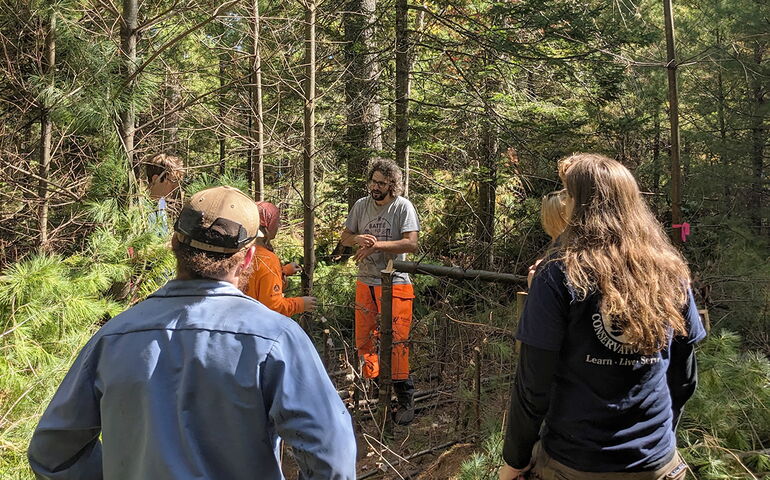 Photo / Courtesy David Ayers, New England Forestry Foundation
New England Forestry Foundation forester Mike Redante leads a discussion with Maine Conservation Corps volunteers at True Farm Living Forest in Mechanic Falls.
Photo / Courtesy David Ayers, New England Forestry Foundation
New England Forestry Foundation forester Mike Redante leads a discussion with Maine Conservation Corps volunteers at True Farm Living Forest in Mechanic Falls.
Forestland owners in Maine and across New England have an opportunity to improve their forest management practices and grow markets for regional wood.
The New England Forestry Foundation received $32 million from the U.S. Department of Agriculture for its new Advancing Markets for Producers program, which will run through March 2028 to help landowners implement forestry health, ecological integrity and timber productivity practices across 50,000 acres.
The award will also support the foundation’s work with forestland owners, loggers, foresters, forest products businesses and wood consumers to advance the productivity of working forests and expand local markets for wood products.
“It is great for our sector to have additional resources available for investing in timber stand improvements, which are critical to future wood supply and value, but difficult for landowners to make when wood markets are challenging,” said Kyle Burdick, vice president of the Baskahegan Co., a forestry services company in the Washington County town of Brookton.
The program could help Baskahegan get more quality wood growing faster on more acres, he added.
The foundation will send 65% of the award directly to producers as incentives.
The precise number of incentivized acres will depend on forest type, forest stand condition and forestry practices applied, according to a news release.
A total of 23 commercial, conservation and public forest landowners have already enrolled in the project in Maine, New Hampshire, Vermont, Massachusetts and Connecticut.
Smaller-acreage landowners are encouraged to apply, with some already in the queue.
“As a company that is involved in both sustainable forest management and milling wood products, we always have our eye on future wood supply,” said Catherine Robbins-Halsted, vice president of the Robbins Lumber Co., a lumber manufacturer and distributor headquartered in the Waldo County town of Searsmont.
Support toward foresters and logging contractors will include training on forest management and market topics through a partnership between the foundation and the Professional Logging Contractors of the Northeast, an educational nonprofit focused on logging and associated trucking issues throughout the Northeast, predominantly in Maine.
“By expanding the number of master logger certified companies and making more available to harvest uneconomic stands responsibly, this grant is critical to the forest economy and to employment in rural communities that depend on it,” said Dana Doran, the group's executive director.
A market development program will link regional and local producers and consumers of wood, including landowners, loggers and mills that produce wood products, along with project developers, architects and builders that drive demand for wood in the building sector.
Through outreach, education and marketing, the program is expected to advance markets for producers by increasing the volume and variety of wood products used in buildings, particularly housing, including increasing the prevalence of mass timber as a structural building material.
Last month, a team from the foundation visited Robbins Lumber and NotchSB, a prefabricated cross-laminated timber home-builder in Belfast, for a better understanding of the regional challenges and opportunities of wood sourcing, such as tracking where wood comes from and how it was grown, according to the foundation’s blog.
Cross-laminated timber, or CLT, is a type of engineered wood product that binds several layers of solid lumber boards together by stacking them crosswise to create a strong and more durable panel for structural building applications.
Robbins Lumber owns and runs a sawmill for Maine’s white pine lumber industry, manages 30,000 acres across Maine and sources wood from forests within a 150-mile radius of its facility.
In Belfast, NotchSB’s leaders discussed the potential for sourcing local wood for upcoming building projects.
The Giving Guide helps nonprofits have the opportunity to showcase and differentiate their organizations so that businesses better understand how they can contribute to a nonprofit’s mission and work.
Learn More
Work for ME is a workforce development tool to help Maine’s employers target Maine’s emerging workforce. Work for ME highlights each industry, its impact on Maine’s economy, the jobs available to entry-level workers, the training and education needed to get a career started.
Learn More
Whether you’re a developer, financer, architect, or industry enthusiast, Groundbreaking Maine is crafted to be your go-to source for valuable insights in Maine’s real estate and construction community.
Learn moreThe Giving Guide helps nonprofits have the opportunity to showcase and differentiate their organizations so that businesses better understand how they can contribute to a nonprofit’s mission and work.
Work for ME is a workforce development tool to help Maine’s employers target Maine’s emerging workforce. Work for ME highlights each industry, its impact on Maine’s economy, the jobs available to entry-level workers, the training and education needed to get a career started.
Whether you’re a developer, financer, architect, or industry enthusiast, Groundbreaking Maine is crafted to be your go-to source for valuable insights in Maine’s real estate and construction community.
In order to use this feature, we need some information from you. You can also login or register for a free account.
By clicking submit you are agreeing to our cookie usage and Privacy Policy
Already have an account? Login
Already have an account? Login
Want to create an account? Register
In order to use this feature, we need some information from you. You can also login or register for a free account.
By clicking submit you are agreeing to our cookie usage and Privacy Policy
Already have an account? Login
Already have an account? Login
Want to create an account? Register
This website uses cookies to ensure you get the best experience on our website. Our privacy policy
To ensure the best experience on our website, articles cannot be read without allowing cookies. Please allow cookies to continue reading. Our privacy policy









0 Comments