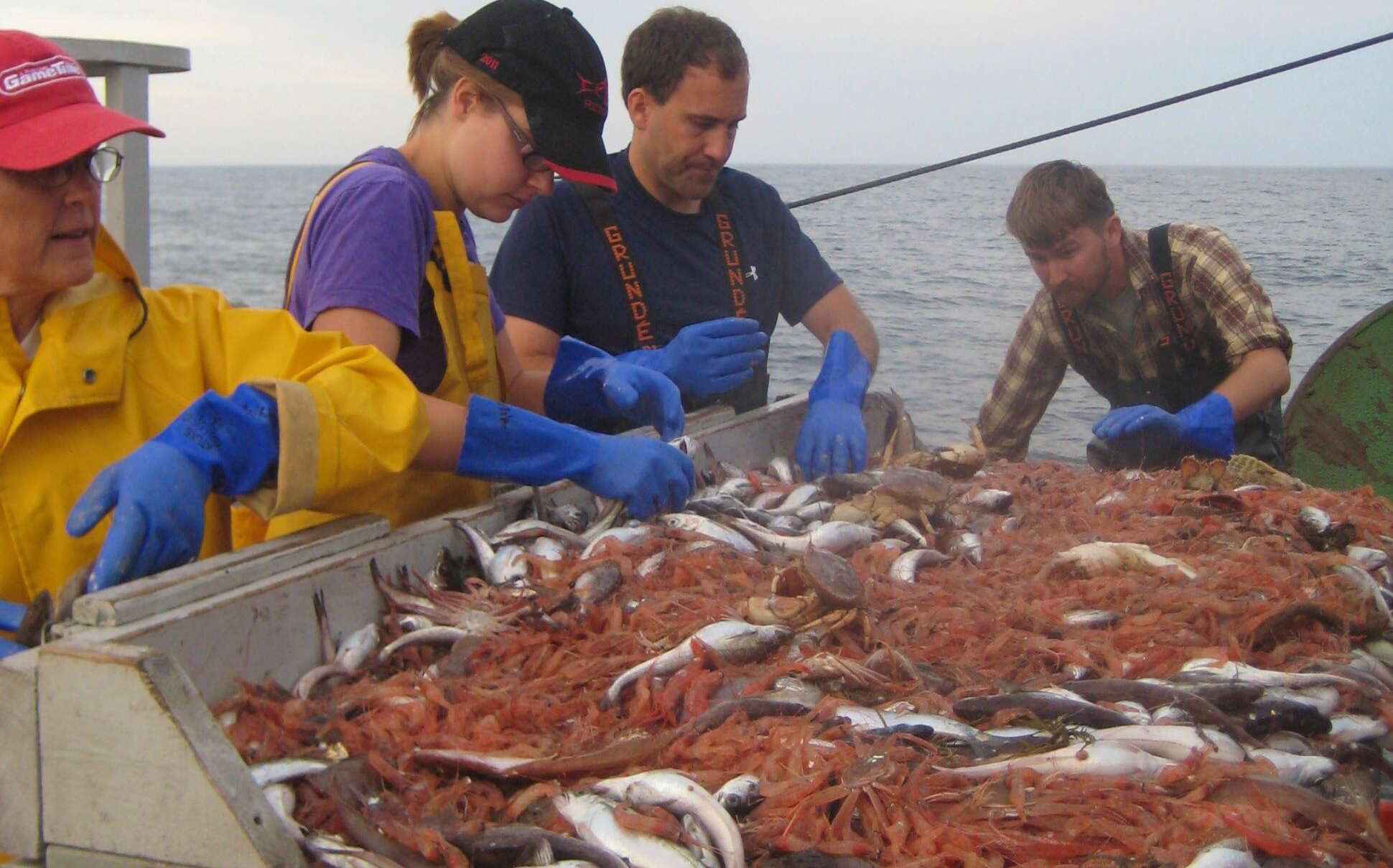
Photo / Courtesy NOAA Fisheries
Scientists aboard a federal research vessel sorting shrimp catch during a Gulf of Maine survey.
Please do not leave this page until complete. This can take a few moments.
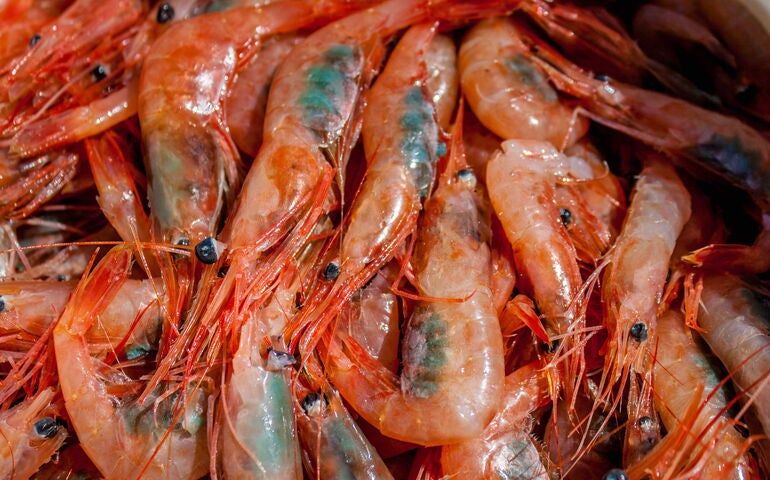 Photo / Courtesy NOAA Fisheries, Calvin Alexander
Atlantic northern shrimp (Pandalus borealis) caught in the Gulf of Maine during the 2019 F/V Karen Elizabeth twin-trawl wingspread study.
Photo / Courtesy NOAA Fisheries, Calvin Alexander
Atlantic northern shrimp (Pandalus borealis) caught in the Gulf of Maine during the 2019 F/V Karen Elizabeth twin-trawl wingspread study.
A moratorium on shrimp fishing that’s been in place since 2014 has been extended another three years, to 2028.
The Atlantic States Marine Fisheries Commission’s Northern Shrimp Section maintained the moratorium due to the persistence of low biomass levels over the past decade despite the lack of fishing.
Regulators attributed low shrimp levels to warming ocean temperatures and predation, although they said both indices recently showed improvement.
The section also suspended its annual sampling program for 2026. But the program, which assesses stock abundance, could be reinstituted in 2027 if recruitment and/or temperature triggers are tripped.
While Maine’s northern shrimp fishery is closed, frozen shrimp from Canadian fisheries are available.
Following high landings in the late 1960s and early 1970s, the fishery was closed in 1978 due to a stock collapse. It reopened the following year, and landings increased throughout the 1980s and 1990s before dropping again. For several seasons before the 2014 moratorium, the commercial season was closed early due to landings exceeding the catch limit.
Fishermen mainly use otter trawls — a funnel-shaped fishing net — to harvest northern shrimp, although some Maine fishermen use traps.
The fishery is seasonal in nature, peaking in late winter when egg-bearing females move into inshore waters where the eggs hatch.
Northern shrimp are found in the western North Atlantic from Maine to Massachusetts, but the bulk of the harvest comes from Maine. They are also found and harvested on the West Coast and in Alaska, Canada, Greenland, Iceland and Norway.
The fishery was last open in 2013.
In 2011, fishermen harvested about 13 million pounds, far exceeding the total allowable catch of 8.8 million pounds. For 2012, harvesters exceeded a lower allowable catch of 4.9 million pounds.
The landings dropped. In 2013, the allowable catch was 1.4 million pounds, but harvesters took in only half of that.
Around that time, a stock report said abundance and fishable biomass for 2012 through 2015 were the lowest on record for a 32‐year time series.
Just before the original moratorium, about 500 Maine fishermen held licenses and Maine represented about 90% of the fishery. In 2013, the last year of fishing, about half of the 500 had any landings.
Northern shrimp are sensitive to ocean temperatures, with higher spawning biomass and colder temperatures producing stronger recruitment — the number of young fish that survive to become adults.
The collapse was linked to warming ocean temperatures and squid predation, according to a 2021 study by Anne Richards, a biologist at the Northeast Fisheries Science Center in Woods Hole, Mass., and Margaret Hunter from the Maine Department of Marine Resources Division.
“An extreme heatwave in the Gulf of Maine in 2012 resulted in the warmest ocean temperatures in the region in decades,” the study said.
A stock collapse is a rapid decrease in numbers that is not a natural fluctuation in stock size.
“Scientists studying the collapse have found that during this time, warmer temperatures were linked to increases in longfin squid, a major shrimp predator,” the study said. “They arrived in the Gulf of Maine sooner than usual and in more areas where shrimp occur.”
Today, an increase in other shrimp predators — spiny dogfish, redfish and silver hake — might also be contributing to a decline in the stock.
Ocean temperatures are predicted to continue to rise, suggesting an increasingly inhospitable environment for shrimp in the Gulf of Maine.
If recruitment of baby shrimp improves, it still takes several years for them to be commercially harvestable.
The states of Maine, New Hampshire, and Massachusetts cooperatively manage the resource. A short experimental fishery was allowed in 2025.
The Giving Guide helps nonprofits have the opportunity to showcase and differentiate their organizations so that businesses better understand how they can contribute to a nonprofit’s mission and work.
Learn More
Work for ME is a workforce development tool to help Maine’s employers target Maine’s emerging workforce. Work for ME highlights each industry, its impact on Maine’s economy, the jobs available to entry-level workers, the training and education needed to get a career started.
Learn More
Whether you’re a developer, financer, architect, or industry enthusiast, Groundbreaking Maine is crafted to be your go-to source for valuable insights in Maine’s real estate and construction community.
Learn moreThe Giving Guide helps nonprofits have the opportunity to showcase and differentiate their organizations so that businesses better understand how they can contribute to a nonprofit’s mission and work.
Work for ME is a workforce development tool to help Maine’s employers target Maine’s emerging workforce. Work for ME highlights each industry, its impact on Maine’s economy, the jobs available to entry-level workers, the training and education needed to get a career started.
Whether you’re a developer, financer, architect, or industry enthusiast, Groundbreaking Maine is crafted to be your go-to source for valuable insights in Maine’s real estate and construction community.
In order to use this feature, we need some information from you. You can also login or register for a free account.
By clicking submit you are agreeing to our cookie usage and Privacy Policy
Already have an account? Login
Already have an account? Login
Want to create an account? Register
In order to use this feature, we need some information from you. You can also login or register for a free account.
By clicking submit you are agreeing to our cookie usage and Privacy Policy
Already have an account? Login
Already have an account? Login
Want to create an account? Register
This website uses cookies to ensure you get the best experience on our website. Our privacy policy
To ensure the best experience on our website, articles cannot be read without allowing cookies. Please allow cookies to continue reading. Our privacy policy





0 Comments