Campaign aims to build interest in backyard dwellings
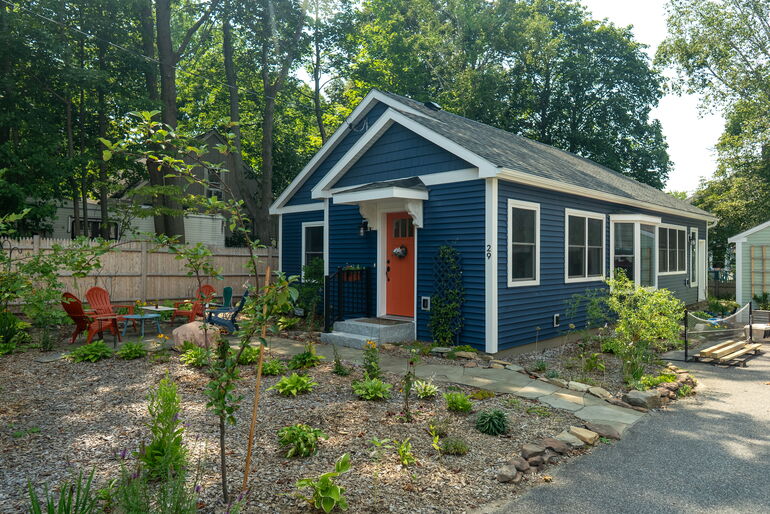 Photo / Courtesy of Tom Bell
A new Maine campaign aims to encourage homeowners to build accessory dwelling units on their properties like this one in Portland.
Photo / Courtesy of Tom Bell
A new Maine campaign aims to encourage homeowners to build accessory dwelling units on their properties like this one in Portland.
To help expand Maine’s housing supply, the Greater Portland Council of Governments is leading an initiative encouraging homeowners to consider building accessory dwelling units on their properties.
An accessory dwelling is a secondary abode on a residential property, either attached or detached, or created by converting a garage or basement.
The Maine Legislature passed a law in 2023 requiring municipalities to revise land-use ordinances to allow at least one ADU on any lot with a single-family home.
Regulations can vary from town to town. The campaign's website, MaineADUguide.org, provides information to help homeowners determine what may be permitted on their property through an interactive tool called the ADU Wizard.
Kristina Egan, executive director of the Greater Portland Council of Governments, said many families are building ADUs for elderly parents or adult children.
“In addition to lowering housing costs, ADUs can bring extended families closer together while still giving people the privacy of a single-family home," she said. "For many families, building an ADU makes financial sense while also improving their quality of life."
The new website includes information on costs, design ideas, financing options and how to find a contractor, and estimates that it can take from 12 to 24 months to build an ADU. Construction costs in Maine can range from $30,000 for an interior or garage conversion to $500,000 for a newly built detached home.
Chris Lee, head of design and development at Brunswick-based Backyard ADUs, said that the structures offer a powerful way to boost housing supply while creating more affordable living options for people at different stages of life.
Andrew Frederick, co-founder of Croft, a Rockland-based firm that manufactures carbon-negative, panelized, prefabricated buildings used as ADUs, said that housing strategies like ADUs "encourage smart, neighborhood-scale infill in existing communities.
"Building alongside existing infrastructure — like municipal water, sewer, and electrical hookups — can reduce construction costs by up to six figures," he noted.
The website and campaign videos were created with $45,000 in funding from the Maine Department of Economic and Community Development's Housing Opportunity Program.
Mainebiz web partners
Most Recent



Most Recent









0 Comments